Italy
Our last two stops in Europe before going back to the USA for a few weeks were in Italy: Tuoro sul Trasimeno for a week, and then Rome for a couple days. Tuoro sul Trasimeno was a great stop, right on the border between Umbria and Tuscany regions and a short drive from many hilltop towns and communes in central Italy. I was pretty excited for this part of the trip as I’d never been to the area, and really liked the foods and wines, but otherwise didn’t know much about it. We didn’t have a specific plan, other than a few spots we were interested in visiting like Orvieto, Spello and maybe Florence. Florence was quite a bit further afield, a 2 hour drive in either direction plus parking would be tough and the timed tickets seemed sold out for the museums we wanted to see, so we chose to keep it easy and just visit the closer towns instead. In the end I think we were pretty happy with how we used this time.

Passignano sul Trasimeno
Passignano sul Trasimeno was the nearest small town to where we were staying other than Tuoro, so we went there on our first day, to make it easy on ourselves. We found a parking spot, then noticed there was a giant triangle tower near the parking lot, so decided to go check it out.

There turns out to be a bit of an old-town there, which had the Torre Triangolare we had seen, as well as the ruins of an old castle, La Rocca di Passignano sul Trasimeno, which had a cafe that doubled as the ticket office, so we got tickets and climbed the stairs of the old keep to see the view from the top. Emily enjoyed roaming around the tower of the old castle, until she realized how many spider webs were on the stairs and then she wanted to leave!

We walked around the old town area a bit more, enjoyed looking at some of the old buildings before making our way down the stairs toward the lake. We had a nice lunch at Il Molo, some Gelato at Tropical Ice cream and browsed the pottery at Marina Regali, before heading back to the AirBnB to play in the pool. We felt like it was an enjoyable first day, no pressure to see a museum or anything.
Orvieto
For our second full day in Italy, I really wanted to check out Orvieto, an old medieval hilltop fortress town that we’d seen in a travel book. Anna had done some research on where to park, and we picked the side of town that had the Funicular to get to the top. We parked at the train station parking lot which is free, and rode the Funicolare to the top of the hill. This Funicular was the fastest one we’d been on. We were early enough that it wasn’t too crowded yet.

Right near the top of the Funicolare was Pozzo di San Patrizio so we headed there first. This well was built between 1527 and 1537 to provide fresh water to the city while it was under siege, as it had been by the Holy Roman Emperor Charles V in 1527. There were two helical staircases to the bottom so you can walk down one and up the other - quite a long walk, and a bit slippery as it was very damp. Absolutely worth it as the windows into the well were quite visually stunning, though a bit difficult to capture in a photo.

After visiting the well, we wandered towards the main city, viewing the ruins of the Etruscan temple of Belvedere near there on the way. I think this was the first time I’d really heard about the Etruscans, who pre-dated the Romans in the area - a fascinating civilization that had active trade with the Romans and other civilizations in the area before they were slowly absorbed into the Roman empire. We didn’t stay there long, as there wasn’t much information beyond a signpost explaining what the ruins were, and we were on our way to a playground before lunch!

Anna and I split up for a couple hours, so Anna could walk around the city looking at pottery and clothing shops, while I took Emily to the playground for a bit. On the way there we poked our head into Chiesa di San Domenico, and played in a little square near the church, before making our way to the playground. The playground was near the edge of the town with a view off the side of the hill which was very pretty and entertained Emily for a bit until she got frustrated with the local kids for not wanting to play with her. We met Anna back at our lunch spot, Trattoria la Grotta where we consumed fresh pasta, salad and wine.
After lunch, we wandered to the other side of Orvieto where we saw the Duomo Cathedral. This church has a striking design of alternating colors of bricks that make a striped pattern on the walls both inside and outside of the church, as well as many gorgeous frescoes in the church itself. There was also a car show going on outside of the cathedral with some gorgeous old cars.

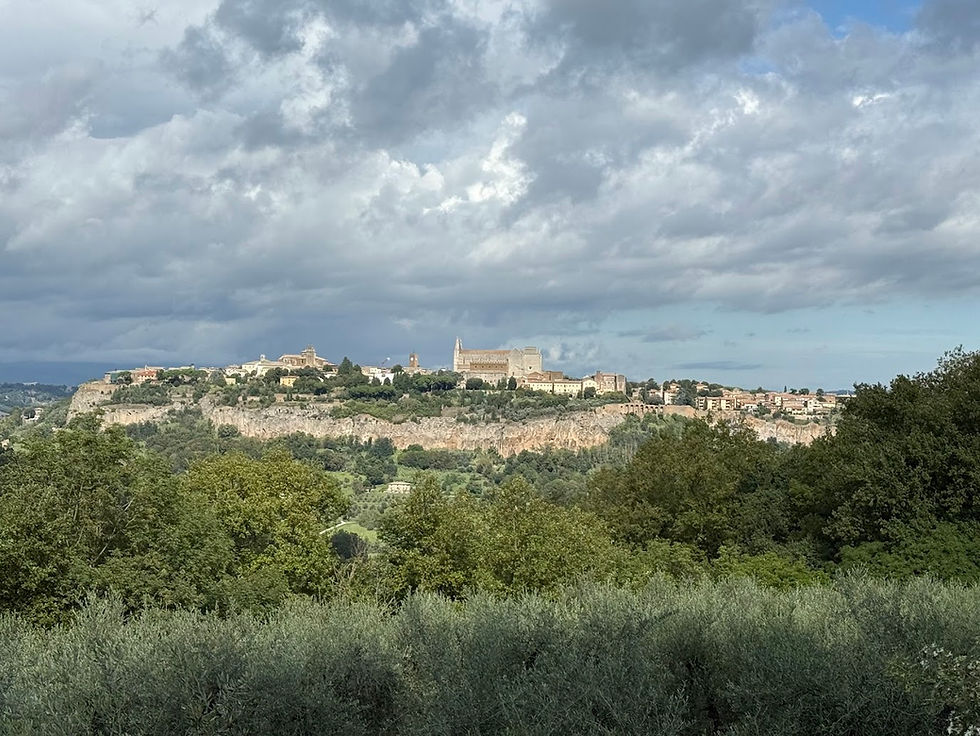
Overall Orvieto was really worth the stop! Unfortunately it was tough to find the best spot to view it from afar, the guidebooks have this pretty picture of the town on top of the hill but you don’t get that photo from near the town itself, though we did try to recreate it when we were on our way back from Civita di Bagnoregio.
Castiglione Del Lago
Our third day in Italy, we picked another nearby town on Lake Trasimeno, Castiglione del Lago. This town is just a short drive from where we were staying. We parked near the waterfront, and didn’t even really have a solid plan as to what we wanted to see here, other than wandering around and finding a place to eat. When we started walking towards the main town, realized there was a castle wall that was just a short walk up the hill, we decided to at least go see the bell tower and castle wall, so we walked up the hill. It turns out there is a walled old town with a few gates and squares at the top of the hill, which was cute and had lots of little restaurants. There was even a cinema festival going on for a few days, which started that night- so they were literally rolling out carpet along the middle of the streets along the square, and had signs listing all the movies they’d have on at each venue.
We stopped for lunch at a place that had pizza on the menu (Ristorante La Cantina), since we hadn’t had pizza in Italy yet, but only once we were ordering our food did they tell us the pizza was not available at lunchtime. Sad! However the food was still quite delicious.

After lunch we wanted to walk around the rest of the old town, so we walked toward the northeastern side, where we found a museum that sold tickets to view the medieval castle - Rocca del Leone. Anna and I had no idea what this was but it turned out to be really interesting. The museum was in an old building that had frescoes on the ceiling of almost every room, as well as some art and portraits on the walls. After viewing the museum, the tour continued by walking down the inner walkway of the town castle wall, and then around the top of the walls of the fortress. Then we climbed the stairs of the fortress tower to see the view of the town from the very top. After that we walked back through the inner walkway again and back out.

After the castle visit, we walked back through the town and had some gelato before heading back to our AirBnB. Even if we had known anything about this town, it would have exceeded our expectations to see the old fortress. It sets the stage that so many of these towns have medieval roots, either Etruscan or Roman, and that folk have been living in this part of the world continuously for many thousands of years. Having 1500 year old castles be part of your town is just normal here.
Corciano
This was a gorgeous little town, centered around about 3 blocks of old town up on the hill in a very medieval layout, with large castle walls and gates surrounding it. However, we were here on a Wednesday and really didn’t see many people at all, and nothing seemed to be open. We couldn’t find an open coffee shop or a playground so decided to move on after an hour or so.

San Feliciano
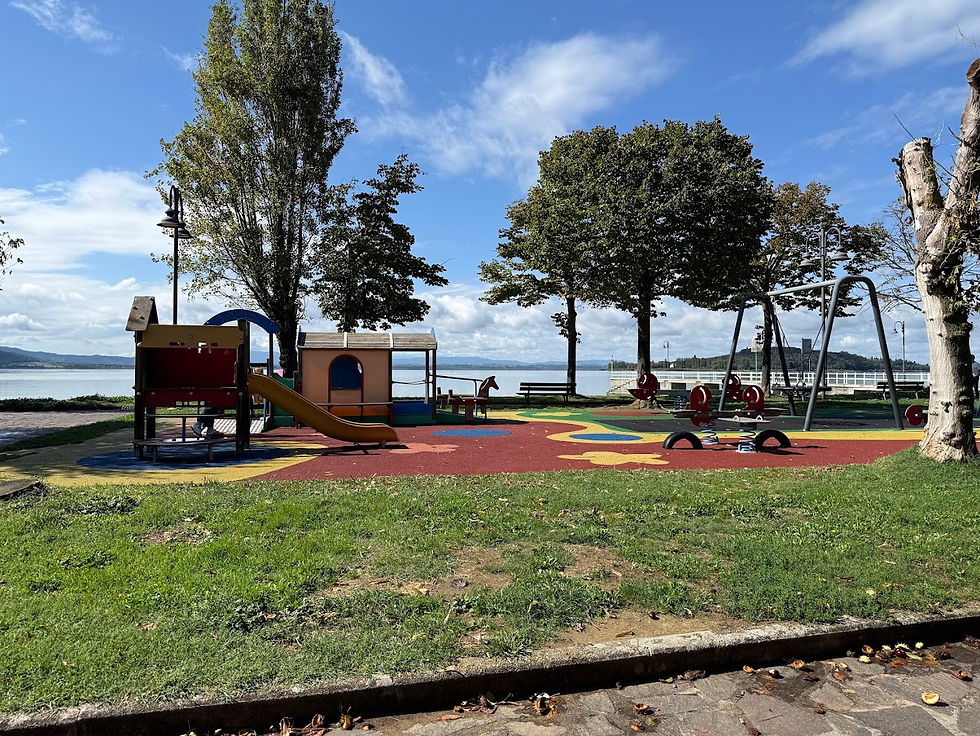
Here we just went to a playground by the beach and had food at a restaurant a block in. It’s a small town right on Lake Trasimeno, and the ferry to Isola Polvese is here. We didn’t take the ferry as we mostly just wanted to grab lunch. We ate at Trattoria al Campanile which had fantastic pasta called pici, and delicious wine that they sell by the liter.
Cortona
One of our day trips was to a nearby town called Cortona, which is perched up on a hilltop and like many of our other stops had a medieval castle wall surrounding the inner old town. Our main objectives were to spend some time walking in the middle of the old town, have some coffee and lunch, and visit a playground. We started with the playground near the “Fontana dei Delfini” (Dolphin fountain), which was on a ledge overlooking the valley below in a beautiful park. Anna told me about the movie “Under the Tuscan Sun” which we watched while in Italy, a rom-com about a writer who decided to just buy a house while on a trip through Tuscany that her girlfriend had gifted her - the movie was fun, and some of it was filmed in Cortona.
As an aside, I have to admit that after watching the movie “Under the Tuscan Sun”, I did start looking at the real estate places’ windows that had property listed for sale and daydream about buying a place of my own there! Did you know that you could basically just buy a place and get an “Elective residency” visa? Obviously there’s lots of fine print and you have to have enough money to buy a place and live here for a while without work, but it was a fun thought exercise anyway. At any rate, the Dolphin Fountain made an appearance in the movie, among other things, and we enjoyed discussing the idea of living here as it really is beautiful.
After the playground, we walked toward the main town area on the Via Nazionale and stopped at a coffee place in the square across from the MAEC “Museo dell'Accademia Etrusca e della città di Cortona” - aka the Etruscan Museum. Again the Etruscans come up because Cortona has a number of ancient Etruscan walls and buildings in the city, which was a major crossroads in the Etruscan civilization, until the Roman times where a different road was built that bypassed Cortona. We enjoyed our coffee there, but did not go to the museum as we didn’t think Emily would be interested.

After our coffee we walked around the back side of the town, where there were alley ways near the old town wall, and a square that had a church and a diocesian museum. The church did not seem opened to tourists at the time, so we moved on to go to our lunch spot: Trattoria Croce del Travaglio, a pizza place where we were finally able to eat actual Italian pizza for the first time on this trip! It was absolutely delicious. After the pizza, Emily and I wandered along the Via Nazionale, finding some gelato and poking our heads in some pretty alleyways that had art studios all along side, while Anna popped her head in some pottery shops.

Around this time, a storm blew through and absolutely drenched us with rain so we had to pop into a covered alley to stay dry. Rain wasn’t in the forecast so we didn’t have coats or umbrellas or anything! But it blew over pretty quickly, after which time we met back up with Anna and went home.
Spello
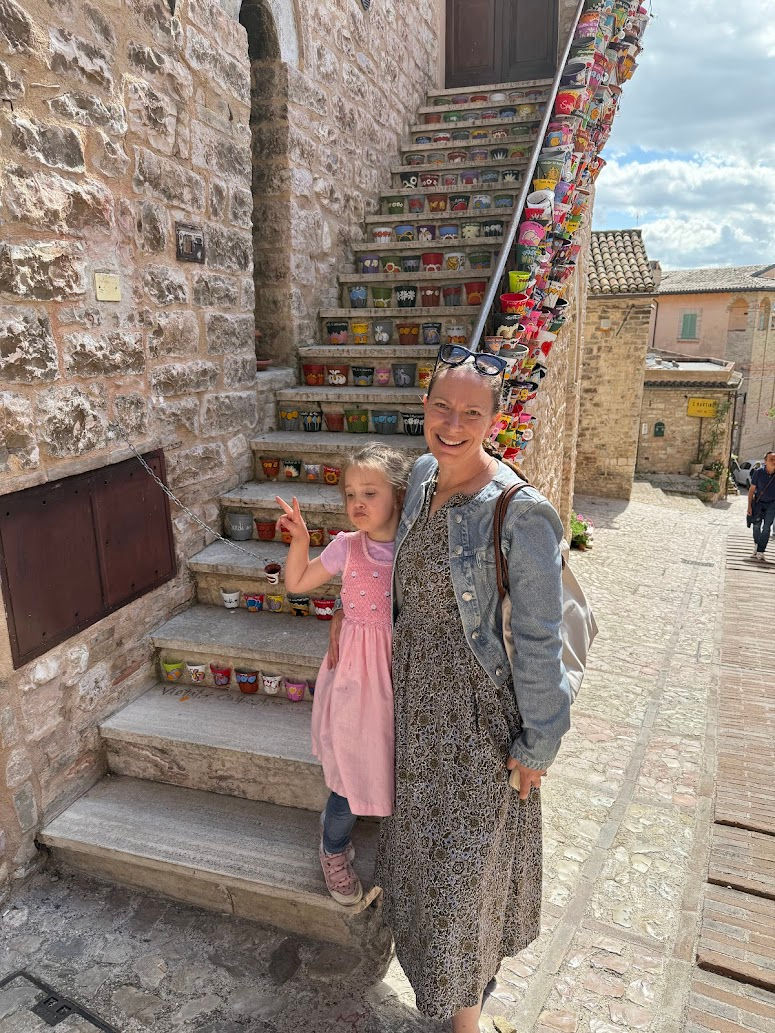
Spello is also known as the City of flowers - they apparently line the streets with flowers and flower petals in a celebration called Infiorate that happens during Corpus Christi festival every year. We certainly saw a lot of flowers when we were walking around, but apparently being there for Infiorate is its own special experience. We visited mostly to walk around the medieval town, visiting a playground, gelato shop and pottery store as we did in almost every town. This town was definitely pretty!
On the edge of the city there is an old Roman arch, though it wasn’t any architectural masterpiece. When we walked over to that side of town to see it, we enjoyed the view of the valley underneath and an art installation near there. Emily made friends with a local cat, that we saw nearly get into a fight with a quite aggressive pup which was fortunately on a leash.

Wine Tasting at Montemelino
Anna, Emily and I went to the Montemelino vineyards for a tour and a tasting. The tour guide showed us all around their property, describing the various wines they grew, the processes they followed (Hand-weeding, hand-pruning and hand-picking the grapes, over their entire property with a small staff!) They grow many different varietals of grapes, as well as olives and some livestock. Emily got to feed the donkeys while Anna and I enjoyed tasting their wines and olive oil! The vineyard was quite close to our AirBnB in Tuoro. It was interesting to hear about how they’re trying to preserve many of the local varietals.

Civita di Bagnoregio
Our last day in Tuoro, we packed up and started our drive to Rome (about 3 hour drive with traffic), we decided to make a small detour near Orvieto to see another hilltop village, Civita di Bagnoregio. Bagnoregio is the larger town, but Civita is the small village that’s perched on top of a hill in the middle of a giant valley, with a very small little bridge connecting it to the main town. We’ve seen a few hilltop towns on this trip, like Mont Saint-Michel, St Malo, and Orvieto, but this place was the most visually striking approach to any of them. The drop on the side is hundreds of feet, and the village itself is quite small, just a few blocks. There are 16 residents, but lots of short term rentals, restaurants and shops along the one main street. It was formed 2500 years ago by the Etruscans, but is at risk of completely disappearing due to constant erosion of the soil it sits on. The main square itself seems pretty chill, you wouldn’t know you were on such a small little hill from the vantage point there. This was a breathtaking sight though and I’m super glad we took the detour, which really only cost us a couple hours including the walk and lunch.

Rome
We went back and forth on how much time we wanted to spend in Rome. On one hand, there is so much history to see and that has been one of the things about Europe that I’ve really enjoyed digging more into for the last few months, but on the other we didn’t think it would be interesting for Emily and she’s really been having more fun in the more rural settings. In the end we did decide to go to Rome for a couple days before leaving, booking a babysitter for Emily for a day so Anna and I could tour the Vatican museum and Sistine Chapel.
Colosseum and Roman Forum
I knew we were only here for a couple of days, so getting to these sights was going to be pretty unlikely. We did end up walking around the Colosseum, and finding some Invader art, but the line for the Forum was way too long for us to even consider it. We ended up going on an invader hunt instead and just eating some yummy food and gelato nearby.

Trevi Fountain
Trevi fountain had a massive line to get up to it but the line went pretty quick. Emily threw a couple coins in and made a wish “to have more coins” haha. What a pretty fountain, too bad making it such a spectacle somewhat diminishes the beauty.

Vatican Museum and Sistine Chapel, and Michaelangelo
For our anniversary proper, I booked a babysitter and Anna booked us a tour through the Vatican Museum and the Sistine Chapel. The guide was fantastic. She was an Australian, who had a double major in Art and Art History, and in particular she was a huge fan of Michaelangelo, so having her describe the various restorations of sculpture and original sculptures of his, as well as how his time in Florence doing dissections influenced his anatomy, his restorations, his sculptures and even his paintings was pretty amazing.
I didn’t know much about either the Vatican Museum or the Sistine Chapel, other than that they were famous sights in the Vatican, and that they were super busy - and I also knew very little about Michaelangelo. We had grand plans to go to Florence, but even there wouldn’t have been able to see the David sculpture as the tickets were all sold out by the time we even thought to book them… but the guide told us many things about Michaelangelo, and pointed out many of the works he did other than just frescoes. For one, he was hired to do two major jobs, designing the structure of St Peter’s Basilica’s massive dome, which is one of the largest self supporting domes in the world, built entirely out of stone. I knew he did the art around the area but it blew my mind that the same guy also did the engineering design for some of these structures.

The guide claimed that Michaelangelo did many restorations of sculptures that were acquired or discovered by the church from Roman and Greek times, however I haven’t found any evidence to support that claim! I’d love to hear from anyone who has knowledge on that aspect of his life. I’m also looking for a book on the subject as it seems way more interesting than I’d previously known. (I really enjoyed the Van Gogh and Jackson Pollock books, but haven’t found anything in similar depth about Michaelangelo yet!)
At any rate the tour through the Vatican museum was overwhelming in multiple dimensions. The guide claimed it’s second only to the Louvre in completeness, which I can believe having spent a few days at the Louvre and really feeling like it still hasn’t actually been absorbed yet. (Seems it’s only fourth in gallery space). What was super interesting to me in the Vatican museum were two things:
1. The Etruscan exhibits just seemed to keep on going. I mentioned earlier that the Etruscans were interesting to me, as we’ve seen a few things about them on our journey through Italy, and they pre-dated and later integrated into the Romans later on. Unfortunately many of the sculptures and artifacts from the Etruscans that were discovered were made out of terra cotta which is not the most resilient of materials for longevity, but even so the Vatican Museum had 6 or so rooms of sculptures from the Etruscans, of many types and in reasonably decent condition.

2. The Greek and Roman sculptures. These things also just kept on going. It starts out with some of the more exciting works, and larger and more unique sculptures, but by the end of the tour there are some rooms that just have hundreds or thousands of old greek busts, each of which was some politician of note, but which aren’t important enough to have their own section of the museum - but the church felt they were important enough to preserve and hold in the museum. The scale of these preserved works is mind blowing but also exhausting, and by the end you’re just like okay I’ve seen enough, I get it, there are tons of these works! Let’s move on. Even though each one is an incredible artifact of history.

At any rate, this museum is apparently known for this- especially during peak season, you just feel like you’re being pushed through by mobs of people and get overwhelmed by how many works you’ll see in your time there. We apparently picked a good time, but still ended up being rerouted a couple times to reduce the flow of people through the main works.
Right before getting to the Sistine Chapel, there’s another hall which is massive, the Gallery of Maps- there are 40 massive tapestry panels hanging on either side of this 120 meter long hallway, which depict the entire known map of Italy from when they were commissioned in 1580, and remain 80% accurate today. This was pretty impressive on its own, but to make things even more ridiculous, the entire ceiling of the hallway had impressive frescoes as well.

The Sistine Chapel has Michaelangelos’ works on the ceiling, primarily 9 scenes from The book of Genesis. There is a lot of other artists work around the walls of the chapel from other well known artists, and tapestries on the walls from his competitor Raphael, but between The Last Judgement and The book of Genesis (including The creation of Adam), Michaelangelo’ contributions to the Sistine chapel are still considered to be one of “the greatest masterpieces of all time”. I have to admit I was left pretty impressed by the work, though it’s really quite difficult to fully appreciate when you’re surrounded by so many people also trying to enjoy it!
This was our last major stop in Italy and in Europe, but it was a pretty great way to end this leg of the trip! Off to Minneapolis and Seattle next, on our way to Australia for a few months!


Comments